
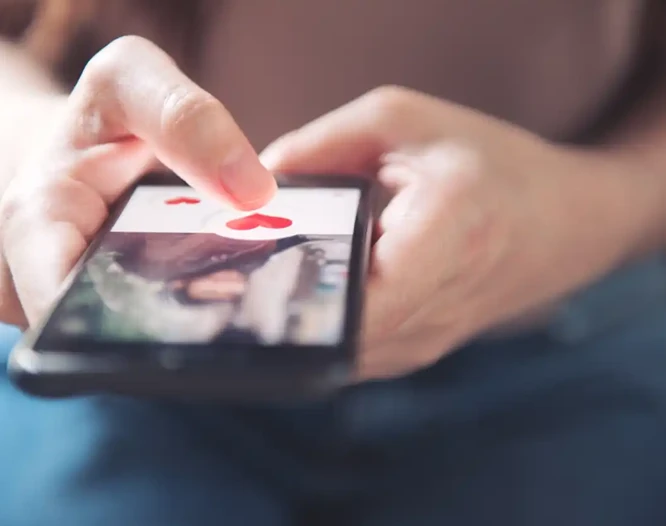
Specifically, today we’re talking about online dating.
We all want to present our best selves, but how do we know when someone is telling us the truth?
Or conversely, are you unable to show your true self because you don’t know how to present yourself on dating apps?
We live in an era where meeting someone through a screen is, for many, the first step toward a potential relationship. Dating apps have become the new bar, the new town square, the new social space where attraction begins with a swipe.
But… who are we really when we’re on these apps? And how much of a difference is there between our online profile and our real selves?
At The Net Psychology, we refer to this as the “digital self”: that version of yourself you create when you decide how to present yourself in a virtual environment.
Do we show ourselves or sell ourselves?
When we open a dating app, we usually carefully choose which photos to show, which words to use in our bio, which details to share (and which not to). We don’t always lie, but we do curate a version of ourselves. Does this sound familiar?
You select a photo where you look good… even though it was taken three summers ago.
You say you like hiking… but you don’t mention that you only did it once out of obligation.
You say you love books, but the last novel you read was in 2021. This isn’t necessarily a bad thing. We all want to show our best side. The problem arises when the gap between our digital self and our real self is so wide that it becomes difficult to maintain.
Why do we create idealized versions of ourselves?
From a cyberpsychology perspective, we understand that the digital environment fosters certain mechanisms:
Narrative control: online, we can think before we respond, choosing each word, each image. In real life, spontaneity gives us away.
Desire for acceptance: we want to be liked, we want to connect. This can lead us to exaggerate qualities or downplay aspects we think might not be attractive.
Showcase effect: we feel like we’re in a human catalog, where we have to stand out to avoid being discarded.
The Risk: Relationships Based on Fictional Versions
When we meet someone face-to-face after meeting them online, there’s a moment of adjusting expectations. If that person doesn’t resemble the image they projected, disappointment, mistrust, or even rejection can arise.
Conversely, if you’ve created a persona yourself, you might feel anxious about “not living up” to your own avatar.
What can we do to be more authentic while still maintaining our image?
Here are some key points from cyberpsychology:
Ask yourself real questions: Is what I’m showing a part of me or an invention? Could I maintain this image if this person met me in real life?
Choose strategic honesty: You don’t have to reveal everything, but you can show the essence of your personality without embellishing it.
Remember that true connection stems from authenticity: attracting people through affinity, and not just visual impact, can lead to stronger relationships.
And you? Do you recognize yourself in your dating profile?
At @thenetpsychology, we help you navigate all the barriers and doubts that online dating presents, so finding a partner can be a pleasant, fun, and successful offline experience. #cyberpsychology #onlinedating #single #love
Want to learn more?
Write to me and follow us to discover more about Cyberpsychology.